Moon Phase on July 28, 2025
Lunar phases have guided human activities and shaped natural rhythms for thousands of years. From planting crops to cultural celebrations, the Moon’s cycle influences the Earth in subtle but important ways. On July 28, 2025, the Moon enters a Waxing Crescent phase, a moment where the lunar surface gently brightens after the New Moon. This phase holds a special place in the moon’s monthly journey, offering both a visual treat and a range of natural effects.
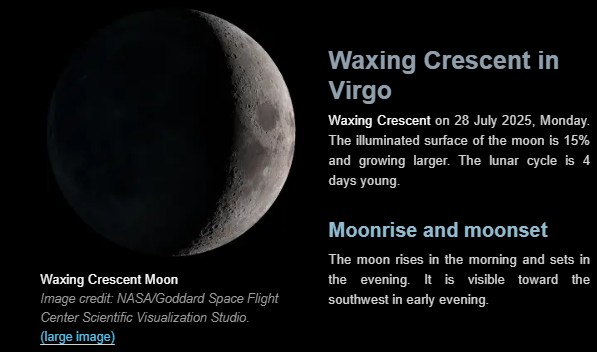
Detailed Description of the Moon Phase on July 28, 2025
On July 28, 2025, the Moon will be in the Waxing Crescent phase. This phase occurs after the New Moon, when the Moon begins to show a sliver of light on its right side, growing fuller each night. By this date, the Moon is about 4 days old in its 29.5-day cycle and roughly 15% illuminated.
A Waxing Crescent marks the start of the Moon’s slow climb toward its First Quarter, where half the surface will be visible. It’s a sign that the lunar glow is awakening, slowly appearing as a thin arc in the twilight sky. This crescent shape grows larger night after night, symbolizing new beginnings and forward momentum in many traditions.
Visual Characteristics of the Waxing Crescent
If you step outside on the evening of July 28, look towards the western sky shortly after sunset. The Moon will appear as a delicate crescent, its curve sharp and bright against the fading daylight. The shaded part of the Moon is faintly visible, thanks to Earthshine — sunlight reflecting off the Earth and softly illuminating the dark areas of the lunar surface.
The crescent will widen enough to outline some craters and mountains along the lunar terminator — the boundary where day meets night on the Moon. This shadow line highlights the Moon’s rugged landscape in a way that only early and late phase Moons can do, providing a textured, three-dimensional look.
Astronomical Position and Distance from Earth
On July 28, the Moon resides in the zodiac constellation Virgo, positioned about 21 degrees into this sign. The Moon’s orbit will be nearly 394,000 kilometers from Earth, slowly moving toward its farthest point or apogee, expected in early August 2025.
At this distance, the Moon appears slightly smaller when viewed from Earth compared to when it’s closer during perigee. Its orbit’s elliptical shape means the Moon’s size and brightness subtly change, but on this date, it still commands impressive presence in the night sky.
Significance and Effects of the Moon Phase on July 28, 2025
The Waxing Crescent phase is more than a pretty sight. It’s connected to important natural cycles and cultural rhythms. This phase plays a role in regulating tides and setting the stage for the Moon’s phases that follow.
Tidal Effects and Earthshine Phenomenon
During a Waxing Crescent, the Sun and Moon are at an angle that produces neap tides—meaning the difference between high and low tide is less extreme. Expect milder tides, which influence coastal ecosystems and marine life patterns.
At the same time, Earthshine becomes visible. This soft glow, sometimes called the “Da Vinci glow,” occurs because sunlight reflects off Earth’s oceans and clouds, casting faint light on the Moon’s darkened portion. This effect makes the entire lunar disk subtly visible, creating a magical celestial glow that’s often missed without knowing what to look for.
Cultural and Observational Importance
Many cultures see the Waxing Crescent as a symbol of growth, clarity, and new ventures. It often marks a phase for intention-setting or quiet reflection.
For astronomers and moon watchers, this phase is ideal for noticing the Moon’s surface features. The contrast along the terminator reveals craters and mountains in fine relief. This makes the Waxing Crescent a favored time for lunar observations and astrophotography.
Practical Tips for Observing the Moon on July 28, 2025
If you’re planning to catch the Moon on this specific date, here’s how to make the most of your observation.
Best Viewing Times and Locations
Look for the Moon just after sunset in the western sky. The light will be soft and the crescent clearly visible before the sky turns fully dark.
Minimal light pollution helps a lot. Find a spot away from bright city lights, preferably with a clear view of the horizon. The Moon will be higher in the sky shortly after sunset, making early evening your best window.
Using Equipment and Techniques
Even simple binoculars will boost the Moon’s features, making the crescent’s curve and shadows pop. A small telescope provides greater detail, bringing forward surface textures along the terminator.
For photographers, try using a low ISO setting and a quick shutter speed to capture the bright crescent without overexposure. Including some Earthshine can add drama — longer exposures help reveal this faint glow. A tripod is essential to avoid blur during longer shots.
Conclusion
The Moon phase on July 28, 2025, offers a quiet but striking moment in the lunar cycle. The Waxing Crescent, at about 15% illumination and 4 days young, presents a slender crescent glowing in the western sky after sunset. Its position in Virgo and nearing apogee adds layers of astronomical interest.
Whether you’re drawn by tides, cultural meanings, or simply the beauty of Earth’s nearest neighbor, this phase invites you to appreciate the Moon’s subtle transformations. Mark your calendar and step outside that evening to connect with the gentle promise of the Waxing Crescent Moon.
Leave a Reply